The landscape of woodwind performance accessories has evolved significantly with the introduction of advanced synthetic options for instruments like clarinets, saxophones, and oboes. Players seeking consistency, durability, and reliable performance across different playing conditions often turn to engineered alternatives. These modern options utilize specialized polymer fibers, resins, and carefully blended natural cane elements to replicate the traditional acoustic properties required by musicians.
When selecting synthetic oboe reeds and related woodwind accessories, understanding the specific construction methods, cuts, and dimensional specifications helps performers make informed choices. Whether looking for options that require no soaking or seeking precise European cuts for specific mouthpieces and instruments, the market offers diverse configurations tailored to both beginners and advanced instrumentalists. This editorial review examines multiple options available today, detailing their distinct structural attributes and design features.
1. D’Addario VENN Clarinet
Best for players seeking an advanced synthetic reed construction combining polymer fibers, resin, and natural cane for Bb clarinet performance.

The D’Addario VENN G2 Synthetic Clarinet Reeds bring a sophisticated engineering approach to woodwind accessories. By blending polymer fibers, resin, and natural cane, this product creates a material matrix designed to mimic the response and tonal warmth of organic cane while offering the mechanical resilience inherent in synthetics. Tailored specifically for Bb clarinet use, it provides players with a consistent playing experience across practice sessions and performances.
Featuring a strength rating of 3.0, this reed caters to musicians who require a medium resistance profile. The integration of natural cane particles within the polymer and resin matrix bridges the gap between traditional organic feel and modern durability, ensuring that players do not have to sacrifice organic resonance for longevity.
Musicians upgrading their setup will find that this Bb clarinet reed maintains structural integrity without warping from moisture exposure or drying out prematurely, making it a reliable addition to any instrumental case.
What stands out
- Advanced synthetic reed construction utilizing polymer fibers
- Incorporates natural cane alongside resin materials
- Strength 3.0 rating tailored for Bb clarinet instruments
What to consider
- Strength 3.0 may present a specific resistance level that requires adjustment for players accustomed to softer or harder reeds.
- The combination of polymer fibers, resin, and natural cane creates a hybrid construction style that differs entirely from traditional all-cane or 100 percent plastic models.
Bottom line: An advanced Bb clarinet reed option featuring polymer fibers, resin, and natural cane at strength 3.0.
2. 5PCS Medium Oboe Reeds
Best for beginners looking for an oboe instrument accessory that requires no soaking and features specific dimensional specifications.

Designed with accessibility and convenience in mind, the 5PCS Oboe Reeds Medium package offers an oboe instrument accessory tailored specifically for beginners. One of the most notable attributes of these reeds is that they require no soaking prior to playing, eliminating the traditional preparation time usually associated with double reed instruments.
Each oboe in this set is accompanied by a 72mm/2.83″ reed, built with overall dimensions measuring 82 x 13 x 13mm. These precise measurements ensure a consistent fit for standard beginner setups, allowing new players to focus on embouchure development and breath support rather than reed maintenance.
Supplied in a convenient five-piece quantity, this accessory pack provides backups and replacements, ensuring that students and novices have continuous access to working equipment during practice routines.
What stands out
- No soaking required before playing
- Includes a 72mm/2.83″ reed with 82 x 13 x 13mm dimensions
- Specifically designated as oboe reeds for beginners
What to consider
- The medium strength and fixed dimensions of 82 x 13 x 13mm may not suit advanced professional players seeking specialized scrape patterns.
- The pack size of five pieces with 72mm/2.83″ reeds means users must rely on this exact standardized profile without custom trimming flexibility.
Bottom line: A beginner-friendly oboe instrument accessory featuring 72mm/2.83″ reeds that require no soaking.
Related: Understanding the Different Types of Oboe
3. Légère Bass Clarinet
Best for bass clarinetists desiring a premium synthetic reed crafted with a European cut profile.

The Légère Reeds Bass Clarinet European Cut represents precision manufacturing for lower woodwind instruments. As a premium synthetic reed designated by model code BCES300, it brings the renowned Légère synthetic manufacturing process to the bass clarinet, offering performers an alternative to traditional cane.
The European cut profile is engineered to provide a specific response curve and flexibility, accommodating the deep registers and dynamic demands of the bass clarinet. Its synthetic construction ensures that the reed remains unaffected by humidity and temperature fluctuations.
Players utilizing this premium synthetic reed benefit from immediate playability straight out of the packaging, removing the break-in period traditionally required for organic bass clarinet reeds.
What stands out
- Crafted specifically for bass clarinet instruments
- Features the specialized European Cut profile
- Identified by model designation BCES300
What to consider
- The European Cut profile (BCES300) delivers a specific response characteristic that may feel distinct from standard American cut designs.
- As a premium synthetic reed built for bass clarinet, its stiffness and response are predetermined by the manufacturing mold rather than natural cane variations.
Bottom line: A premium synthetic reed featuring a European cut designed for bass clarinet performance.
Related: Understanding the Oboe as a Double
4. Légère European Clarinet
Best for Bb clarinetists seeking the refined response of a European cut premium synthetic reed.

Designed for Bb clarinet players, the Légère Reeds European Cut model BBES350 offers a refined synthetic alternative engineered for demanding acoustic environments. The European cut series is characterized by a slightly shorter, wider vamp design that allows for quick articulation and a centered tone.
As a premium synthetic reed, model BBES350 maintains absolute consistency across temperature and humidity shifts. Players do not need to cycle through multiple reeds or soak them before stepping onto the stage or into the practice room.
The advanced material composition provides the durability required by active musicians, ensuring long-term wear resistance while preserving the tonal clarity expected from high-end clarinet accessories.
What stands out
- Engineered for Bb clarinet performance
- Utilizes the European Cut vamp design
- Specified under model number BBES350
What to consider
- The BBES350 strength and European Cut profile require careful mouthpiece matching to achieve optimal resistance and intonation.
- Synthetic construction means players cannot scrape or modify the reed physically with traditional reed knives in the same manner as cane.
Bottom line: A premium synthetic reed with a European cut tailored for Bb clarinetists.
Related: Mastering the Open Strings on the
5. Légère Eb Clarinet Reeds
Best for Eb clarinetists requiring a specialized European cut premium synthetic reed model.

The Eb clarinet presents unique voicing and intonation challenges due to its high register, making the choice of reed critical. The Légère Reeds Eb Clarinet European Cut, designated as model EBES350, offers a dependable solution engineered precisely for this smaller instrument.
Featuring the Légère premium synthetic reed material, model EBES350 delivers reliable performance without the environmental vulnerabilities of natural cane. It resists cracking, warping, and moisture breakdown during extended practice sessions.
The European cut design optimizes the response of the Eb clarinet, giving performers enhanced control over articulation, dynamics, and high-register stability.
What stands out
- Built specifically for Eb clarinet instruments
- Features the precise European Cut design
- Designated by the model code EBES350
What to consider
- The EBES350 specification offers a rigid structural profile that demands a precise embouchure to prevent pinching in the upper register.
- Being a premium synthetic reed, it lacks the organic dampening qualities inherent in natural cane, altering high-frequency overtones.
Bottom line: A precision-crafted premium synthetic reed with a European cut for Eb clarinet.
6. Légère Alto Saxophone
Best for alto saxophone players looking for the balanced response of the Signature series synthetic reed.

The Légère Reeds Alto Saxophone Signature series, identified by model ASG300, is engineered to provide a smooth, dark tone favored by classical and jazz saxophonists alike. Unlike the European cut, the Signature series features a slightly different geometry designed to be extremely flexible and responsive.
Built from premium synthetic reed material, model ASG300 ensures complete operational consistency. Saxophonists can rely on identical performance characteristics from day to day, eliminating the variability associated with organic cane reeds.
The durability of the synthetic polymer prevents softening during long gigs, ensuring stable intonation and reliable projection from the first note to the last.
What stands out
- Tailored for alto saxophone performance
- Part of the renowned Signature series line
- Designated by model code ASG300
What to consider
- The Signature series (ASG300) offers a distinct flexibility profile that may feel noticeably different compared to stiffer standard or European cuts.
- Saxophonists transitioning from organic cane must adapt to the immediate vibration response of the premium synthetic material.
Bottom line: A premium synthetic reed from the Signature series designed for alto saxophone.
7. Légère Signature Clarinet
Best for Bb clarinetists seeking the refined, flexible acoustic properties of the Signature series.

The Légère Reeds Bb Clarinet Signature series (model BBSS300) provides clarinetists with an advanced synthetic option geared toward expressive artistry. The Signature cut is thinner and stiffer in targeted areas, allowing the reed to vibrate freely and produce a warm, centered sound.
As a premium synthetic reed, model BBSS300 requires zero preparation time. It is ready to play instantly upon removal from its packaging, making it ideal for performers who switch instruments rapidly or require immediate reliability.
The material stability ensures that changes in ambient temperature and humidity will not alter the reed’s performance, providing peace of mind during recording sessions and live performances.
What stands out
- Engineered for Bb clarinet players
- Features the flexible Signature series cut
- Designated by model number BBSS300
What to consider
- Model BBSS300 has a specific thickness profile in the Signature series that requires careful pairing with compatible clarinet mouthpieces.
- Synthetic composition prevents traditional mechanical scraping or filing adjustments if minor resistance tweaks are desired.
Bottom line: A premium synthetic reed utilizing the Signature series cut for Bb clarinet.
8. Légère European Oboe
Best for oboists seeking a premium synthetic reed designed with a European scrape profile.
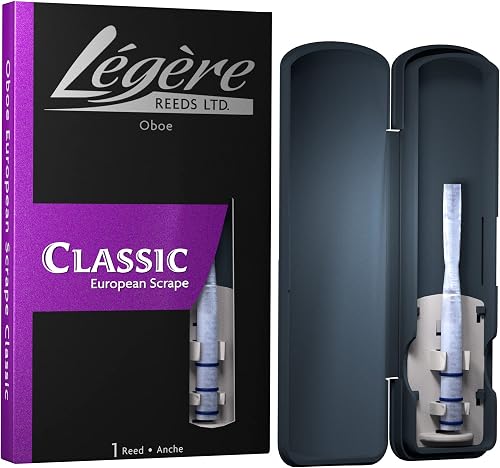
Addressing the specialized needs of double-reed players, the Légère Reeds European Scrape Oboe model DROEM offers a synthetic alternative to traditional hand-scraped cane oboe reeds. The European scrape profile provides a specific resistance and scraping geometry that matches classical oboe performance traditions.
Crafted as a premium synthetic reed, model DROEM withstands the rigors of frequent playing without splitting, warping, or absorbing moisture to the point of degradation. Oboists no longer need to spend hours soaking and adjusting cane reeds before a performance.
This accessory brings the benefits of synthetic technology directly to the oboe community, offering consistent intonation, longevity, and reliable response across all registers.
What stands out
- Engineered specifically for European Scrape Oboe applications
- Built as a premium synthetic reed
- Designated by model code DROEM
What to consider
- The European Scrape Oboe design (DROEM) has a fixed scraping profile that cannot be altered with conventional oboe reed-making knives.
- Transitioning from organic cane to the DROEM synthetic oboe reed requires an adjustment period regarding embouchure pressure and air support.
Bottom line: A premium synthetic reed featuring a European scrape profile designed for oboe players.
Understanding Synthetic Reed Materials
Synthetic reeds for woodwind instruments, including clarinets, saxophones, and oboes, are manufactured using advanced polymer compounds, resins, and sometimes embedded natural cane fibers. These materials are engineered to replicate the complex density and elasticity of organic cane without its inherent vulnerabilities. Unlike organic cane, which absorbs moisture and swells, synthetic alternatives maintain stable physical dimensions across varying climatic conditions.
The manufacturing process involves precision injection molding or CNC cutting to ensure exact tolerances. Whether evaluating the polymer fiber and resin construction of D’Addario VENN products or the specialized diamond-turned cuts of Légère models, modern engineering allows manufacturers to produce reeds with consistent strength grades and predictable response curves.
Comparing Cuts and Scrapes
Different instrument families and playing styles require specific cut geometries, such as the European cut found in models like the BBES350, BCES300, and EBES350, or the specialized European scrape utilized in the DROEM oboe reed. The cut determines how the vamp flexes against the mouthpiece or between the lips, influencing resistance, brightness, and harmonic richness.
For instance, Signature series reeds like the ASG300 and BBSS300 offer different flexibility profiles compared to European cuts. Understanding these variations helps musicians select the correct model for their specific mouthpiece facing and stylistic preferences, ensuring optimal acoustic coupling and effortless projection.
Care and Maintenance of Synthetic Reeds
Maintaining synthetic reeds requires significantly less effort than caring for traditional organic cane. Because materials like polymer resins and advanced plastics do not absorb water, they do not rot, warp, or harbor mold in the same way cane does. Routine maintenance typically involves rinsing the reed with clean water after playing and storing it securely in a protective reed case.
Despite their durability, synthetic reeds should still be handled with care to prevent chipping the tip or damaging the rails. Avoid exposing them to extreme heat sources, as advanced polymers can deform under excessive temperatures. Following these simple guidelines ensures long-lasting performance and consistent acoustic output.
Choosing the Right Strength and Model
Selecting the correct strength grade, such as the strength 3.0 found in the D’Addario VENN G2 or the specific model designations across the Légère lineup, is critical for achieving a balanced embouchure. Synthetic reeds do not break in or soften over time like cane, meaning players must choose a strength that feels correct from the very first use.
Musicians should consider their current mouthpiece opening, playing experience, and stylistic genre when choosing between cuts like the Signature series or European cuts. Consulting manufacturer strength comparison charts also helps bridge the gap when transitioning from traditional cane to engineered synthetic options.
The Evolution of Double Reed Synthetics
While synthetic reeds gained early popularity among single-reed clarinet and saxophone players, recent advancements have expanded into double-reed instruments like the oboe, exemplified by products such as the DROEM European Scrape Oboe reed and beginner-focused options featuring 72mm/2.83″ lengths. Oboe playing places unique demands on the reed due to the closed-channel embouchure and high air pressure requirements.
Engineering synthetic double reeds requires precise balancing of the blade stiffness, scrape gradient, and tube dimensions. As manufacturing technologies continue to refine these parameters, oboists increasingly have access to reliable alternatives that reduce preparation time and offer dependable performance in challenging environments.
Frequently Asked Questions
Do synthetic reeds require soaking before playing?
Most synthetic reeds do not require soaking before playing, unlike traditional organic cane reeds. For example, specific beginner oboe accessory sets explicitly highlight that no soaking is required, allowing musicians to begin playing immediately. Synthetic materials do not absorb water, so they maintain their playing characteristics instantly upon contact with the breath.
Can synthetic reeds be adjusted with a reed knife?
Traditional organic cane reeds can be scraped and modified using reed knives and sandpaper. However, synthetic reeds made from polymers, resins, or advanced composite fibers cannot be scraped or physically modified in the same manner. Players must select the correct strength and model, such as a specific European cut or Signature series option, to match their performance requirements directly out of the package.
How long do synthetic reeds typically last?
Synthetic reeds generally last significantly longer than natural cane reeds because they are immune to moisture degradation, splitting from dryness, and biological warping. With proper care—such as rinsing after use and storing in a secure case—a single synthetic reed can maintain its structural integrity and playing response for months of regular use.
Are synthetic reeds suitable for beginners?
Yes, many synthetic options are well-suited for beginners. Products designed specifically for new players, such as dedicated oboe accessories with fixed 72mm/2.83″ dimensions, remove the complexity of reed soaking, adjustment, and frequent replacement. This allows students to focus entirely on fundamental embouchure development and tone production.
How do European cuts differ from standard cuts?
European cuts, such as those found on select clarinet and oboe synthetic reeds, typically feature a shorter, wider vamp design engineered to provide a quick response, centered core tone, and specific resistance profile. They cater to musicians looking for distinct articulation characteristics compared to standard American or Signature series cuts.
The evolution and refinement of synthetic reeds have transformed how woodwind players approach their equipment across clarinets, saxophones, and oboes. By utilizing advanced materials such as polymer fibers, resins, and specialized organic blends, manufacturers have successfully bridged the gap between the acoustic warmth of natural cane and the mechanical reliability of modern engineering.
Whether choosing a beginner oboe accessory that requires no soaking, a precision-cut European model for clarinet, or a flexible Signature series reed, today’s musicians have access to consistent, durable tools. Understanding the distinct properties of each construction empowers players to select the ideal accessory for their specific instrument and musical goals.