Choosing the right violin bow is a critical decision for musicians at any stage of development, as the bow directly influences tone production, articulation, and overall playability. While modern synthetic materials have grown in popularity, traditional wood options—ranging from classic brazilwood variants to specialized snakewood and pernambuco builds—continue to hold a revered place in the string instrument community. Understanding the structural nuances of different bow profiles helps players select tools that complement their specific instruments and technical approaches.
This editorial overview examines a diverse selection of violin bows available today, highlighting distinct material compositions, frog designs, and sizing categories. Whether you are outfitting a full-size acoustic violin for professional performance or seeking a fractional-size traditional bow for a developing student, analyzing these specific builds provides clear insight into their design priorities. Below, we break down eight notable bow options to help you navigate your next equipment upgrade.
1. VINGOBOW 140V Violin Bow
Best for professional players seeking master-level carbon fiber engineering combined with premium natural horse hair and traditional aesthetic appointments.

The VINGOBOW 140V Master Level bow is designed for full 4/4 size instruments, offering a sophisticated balance point tailored for advanced musicians. Constructed from carbon fiber, this model integrates master-level building techniques to provide structural reliability while maintaining responsive handling across demanding musical passages.
Aesthetic details include Parisian eyes embedded within the ebony frog, adding a classic visual touch to the modern composite stick. The inclusion of premium natural horse hair ensures consistent rosin adherence and clean string contact during extended practice and performance sessions.
Engineered to deliver a sweet sound quality, this bow assists players in drawing out resonant overtones from their full-size instruments. Its well-balanced weight distribution aids in seamless string crossings and articulate bowing techniques.
What stands out
- Master-level carbon fiber construction designed for 4/4 size violins
- Ebony frog featuring traditional Parisian eyes
- Fitted with premium natural horse hair for reliable sound production
What to consider
- Carbon fiber composition alters the traditional weight-to-flexibility ratio compared to natural wood models
- Built specifically for full 4/4 size instruments, making it unsuitable for fractional violin players
The VINGOBOW 140V stands as a robust option for professional players prioritizing the structural consistency of carbon fiber without sacrificing traditional styling elements.
2. Vetimobato 4/4 Violin Bow
Best for adults, students, and beginners looking for a traditional brazilwood fiddle bow sized specifically for full 4/4 instruments.
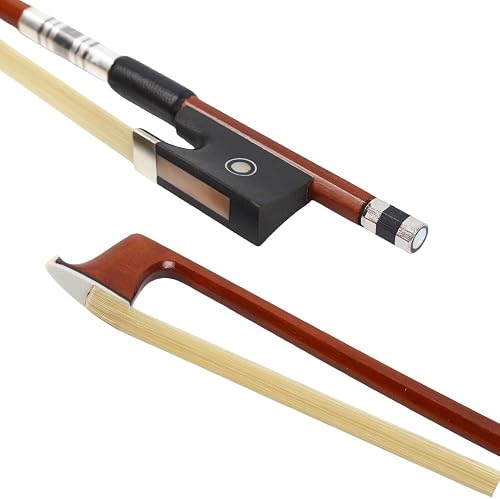
The Vetimobato 4/4 Full Size Violin Bow utilizes a traditional brazilwood stick paired with an ebony frog, offering an authentic playing feel for standard full-size violins. Brazilwood is widely recognized for providing a balanced combination of stiffness and flexibility, making it a staple material for developing and intermediate string players.
Equipped with natural Mongolian horsehair, this bow promotes steady friction against the strings to support clean articulation and tone production. The traditional architecture is designed to accommodate the physical demands of adult players and dedicated students alike.
Serving as a reliable traditional fiddle bow, this model bridges the gap between classic craftsmanship and everyday practice utility. Its construction focuses on delivering dependable handling for players transitioning through foundational skill levels.
What stands out
- Traditional brazilwood stick construction optimized for 4/4 full-size violins
- Features an ebony frog for classic aesthetic and durability
- Strung with natural Mongolian horsehair for consistent response
What to consider
- Brazilwood density can vary naturally, requiring careful individual inspection
- Designed strictly for adults, students, and beginners playing 4/4 instruments
This Vetimobato model delivers essential traditional performance features for standard-sized violins, supporting learners and adult hobbyists effectively.
Related: How to Produce a Rich Violin
3. VINGOBOW 813V Violin Bow
Best for 1/2 size violin players requiring master-level pernambuco construction and warm, flexible acoustic response.

The VINGOBOW 813V brings master-level craftsmanship to a compact 1/2 size format, utilizing a genuine brown pernambuco stick. Pernambuco is prized by string players for its unique cellular structure, which provides exceptional flexibility and dynamic range.
This model features striking visual appointments, including an ebony frog with Parisian eyes, a colorful screw, and elegant winding. These artistic details match the high tier of luthier work typically reserved for full-size professional gear.
Designed to produce a warm, sweet sound, the bow helps smaller instruments project with greater harmonic depth. Its great flexibility allows developing younger players to explore nuanced phrasing and expressive bowing variations.
What stands out
- Genuine brown pernambuco stick scaled for 1/2 size violins
- Master-level appointments including an ebony frog, colorful screw, and elegant winding
- Engineered to deliver a warm, sweet sound with great flexibility
What to consider
- 1/2 fractional sizing restricts this bow to younger or smaller-stature violinists
- Pernambuco bows demand careful humidity management compared to synthetic alternatives
The VINGOBOW 813V offers an uncompromisingly high-tier option for fractional-size players seeking authentic pernambuco performance characteristics.
Related: Discover What Modern Violin Bow Hairs
4. Vetimobato 1/2 Violin Bow
Best for students and young players utilizing 1/2 size violins who need a dependable brazilwood construction.
The Vetimobato 1/2 Violin Bow provides a dedicated fractional-size option crafted from traditional brazilwood. It is built to accommodate the specific physical dimensions and reach of students playing half-size instruments.
By incorporating an ebony frog and natural Mongolian horsehair, this bow maintains standard material pairings expected in educational string accessories. These components work together to provide stable rosin retention and reliable grip on the strings.
Positioned as a traditional fiddle bow for 1/2 violins, it serves as a practical tool for practice routines and lessons. Its balanced weight profile helps younger students maintain proper bowing posture without undue arm fatigue.
What stands out
- Scaled specifically for 1/2 size violins
- Constructed from traditional brazilwood with an ebony frog
- Fitted with natural Mongolian horsehair for dependable friction
What to consider
- Fractional sizing means it will be outgrown as the student progresses to larger instruments
- Standard brazilwood entry-level build may lack the advanced resonance of pernambuco
This Vetimobato fractional bow supplies students with a reliable, traditional foundation for developing early violin technique.
Related: Step by Step Guide to Holding
5. VINGOBOW 610VL Violin Bow
Best for baroque violin enthusiasts seeking an extended snakewood stick with lightweight, easy control.

The VINGOBOW 610VL is an extended edition baroque violin bow measuring 74.5cm, built specifically for historical performance practice. Constructed from exotic snakewood, this model offers a distinct aesthetic and mechanical profile compared to standard modern bows.
Weighing in as a lightweight master-level bow, it emphasizes easy control and agile articulation. This is particularly advantageous for executing the rapid, nuanced bowing styles required in baroque repertoire.
Fitted with premium natural horse hair and structured to maintain a well-balanced feel, the 610VL produces a sweet sound suited to period-appropriate instruments. Its baroque stick geometry reflects historical design traditions.
What stands out
- Extended 74.5cm length tailored for baroque violin performance
- Exotic snakewood stick construction with lightweight design
- Engineered for easy control and a sweet, clear sound
What to consider
- Baroque style geometry requires specialized technique distinct from modern bow holds
- Snakewood material density and stiffness differ significantly from standard pernambuco or carbon fiber
The VINGOBOW 610VL serves as a specialized, high-level choice for musicians exploring historical performance practices on baroque violins.
6. MI&VI NB-510 Violin Bow
Best for ultra-compact 1/8 size violin students needing a lightweight, octagonal silver-mounted brazilwood bow.

Crafted by MIVI Music, the NB-510 model is engineered specifically for the smallest 1/8 size violins. It features an octagonal brazilwood stick, which some players prefer for its slightly sharper corners and distinct tactile feedback compared to round sticks.
The bow is enhanced with an ebony frog and an octagonal silver mount, providing an elevated visual appearance for a fractional-size educational tool. Real Mongolian horse hair is utilized to ensure dependable string contact.
Designed to be lightweight and well-balanced, this bow minimizes strain for young beginners learning fundamental bowing mechanics. Every detail is scaled to match the physical scale of an 1/8 size instrument.
What stands out
- Micro-sized 1/8 scale tailored for very young students
- Octagonal brazilwood stick with silver mount appointments
- Equipped with real Mongolian horse hair and an ebony frog
What to consider
- Extremely small 1/8 sizing makes it a temporary tool before advancing to 1/4 size and beyond
- Octagonal stick profile is a matter of personal player preference
The MI&VI NB-510 provides a well-appointed, lightweight option for the earliest stages of violin education.
7. VINGOBOW Handmade Bow
Best for adults and students seeking a handmade, high-quality brazilwood stick with a clear tone.

The VINGOBOW professional 4/4 full-size bow is handmade to highlight the natural qualities of a high-quality brazilwood stick. This traditional construction method ensures individual attention to camber and weight distribution during production.
Featuring an ebony frog and natural horsehair, the bow is designed to draw out a clear tone from standard full-size violins. The manual crafting process aims to optimize the flexibility and resilience of the brazilwood material.
Aimed at both adults and advancing students, this handmade model bridges traditional luthier techniques with dependable everyday playability. Its balanced architecture supports versatile musical articulation.
What stands out
- Handmade construction utilizing a high-quality brazilwood stick
- Designed for full 4/4 size violins used by adults and students
- Features an ebony frog and natural horsehair for a clear tone
What to consider
- Traditional wooden stick requires routine maintenance regarding humidity and hair tension
- Brazilwood performance varies by individual stick due to natural wood properties
This VINGOBOW handmade offering delivers reliable, clear acoustic response backed by traditional craftsmanship for full-size players.
8. Yinfente Baroque Bow
Best for players exploring baroque-style performance on a 4/4 full-size snakewood bow.

The Yinfente violin bow is built in the baroque style for full 4/4 size instruments, featuring an outward-curved timber stick crafted from snakewood. Baroque bows differ significantly from modern bows in shape, weight, and balance.
The inclusion of natural bow horse hair supports traditional articulation techniques. The snakewood material provides a distinctive visual grain and structural density suited to historical repertoire.
Designed with a focus on well-balanced handling, this baroque style bow assists players in achieving period-accurate phrasing. Its outward timber contour is characteristic of early musical instrument design.
What stands out
- Baroque style design with outward timber contour for 4/4 violins
- Constructed from exotic snakewood
- Strung with natural bow horse hair for historical performance
What to consider
- Outward camber and baroque mechanics require specialized bowing technique
- Snakewood is denser and behaves differently than traditional pernambuco or brazilwood
The Yinfente baroque bow offers an accessible entry point into historical performance styles for full-size violinists.
Understanding Violin Bow Materials
The material composition of a violin bow fundamentally shapes its physical behavior, durability, and tone production. Traditional woods like brazilwood and pernambuco have served as the industry standard for centuries, prized for their organic elasticity and resonant feedback. Brazilwood is frequently utilized for student and intermediate models, offering a forgiving and flexible playing experience that accommodates developing technique. Pernambuco, harvested from the same botanical family, represents a denser and more prized tier of wood selected for advanced and master-level bows due to its superior strength-to-weight ratio and harmonic depth.
In contrast, modern composite materials such as carbon fiber introduce alternative engineering benefits. Carbon fiber bows provide exceptional structural stability, resisting warping caused by changes in temperature and humidity. This makes them highly reliable for outdoor performances, traveling musicians, and players seeking consistent performance without the upkeep demands of natural wood. Selecting between wood and carbon fiber ultimately depends on a player’s tonal preferences, maintenance habits, and sensitivity to traditional weight distributions.
The Importance of Bow Sizing
Matching the correct bow size to the violin and the player is vital for maintaining proper posture, technique, and comfort. Violin bows scale proportionally with instruments, ranging from tiny 1/8 size models for young children up to standard 4/4 full-size versions used by adults and advanced students. Using a bow that is too long or heavy can strain a developing student’s arm and wrist, leading to poor technique and fatigue, while a bow that is too short limits the full sweep of the arm across the strings.
When determining the appropriate size, players should always match the bow size directly to the violin size—such as pairing a 1/2 size bow with a 1/2 size violin. Fractional-size bows maintain the same functional components, including ebony frogs and natural horsehair, but are scaled in length and weight to match shorter arms. As students grow, transitioning through fractional sizes ensures they maintain optimal leverage and control over their instrument.
Frogs, Hair, and Hardware Details
The components attached to the stick—namely the frog, hair, and winding—play significant functional and aesthetic roles in bow performance. The frog, typically crafted from dense ebony wood, anchors the hair at the heel and houses the screw mechanism used to adjust hair tension. High-end bows often feature decorative inlays such as Parisian eyes or mother-of-pearl slides, which enhance the visual elegance of the assembly without altering its primary mechanics.
Natural horsehair, sourced from Mongolian or general equine tails, remains the standard choice for retaining rosin and gripping the violin strings cleanly. The hair requires periodic re-hairing as individual strands wear down or break over time. Additionally, the grip area near the frog—often wrapped with silver wire, silk, or leather—provides tactile traction for the player’s fingers, ensuring a stable hold during intricate bow strokes.
Modern versus Historical Bow Styles
The evolution of the violin bow has led to distinct stylistic categories, most notably the division between modern bows and baroque-style bows. Modern bows feature an inward curve (camber) toward the hair, a heavier head, and a screw-adjustable frog mechanism. This design maximizes downward pressure and projection, making it ideal for standard classical and contemporary repertoire played on modern setup violins.
Conversely, baroque bows feature an outward curve resembling a hunting bow, a lighter overall weight, and often a fixed or clip-in frog design without a metal screw. These historical bows produce a distinct articulation characterized by a softer attack and natural decay, fitting for early music interpretation. Specialty woods like snakewood are frequently used in baroque builds to replicate the historical mass and flexibility required for period-accurate performance.
Maintenance and Care Best Practices
Proper maintenance extends the lifespan and performance consistency of any violin bow, regardless of whether it is constructed from brazilwood, pernambuco, snakewood, or carbon fiber. Players should cultivate the habit of loosening the hair tension slightly after every practice session. Leaving a bow tightened when stored puts unnecessary continuous stress on the wooden or composite stick, which can lead to permanent warping over time.
Cleaning is another essential routine; rosin dust accumulates on the stick and hair during playing and should be gently wiped away with a soft, dry microfiber cloth after use. Avoid touching the horsehair with bare fingers, as natural skin oils degrade the hair’s ability to hold rosin. When storing the instrument and bow, keeping them in a stable environment away from extreme temperature swings and high humidity protects both wood integrity and glue joints.
Frequently Asked Questions
What is the difference between brazilwood and pernambuco?
Brazilwood and pernambuco come from the same botanical species (Caesalpinia echinata). Pernambuco represents the denser, heartwood portion of the tree selected for high-end professional bows due to its superior strength, flexibility, and resonance. Brazilwood typically refers to the lighter or outer wood utilized for student and intermediate bows.
Can I use a full-size bow on a fractional violin?
No, using a 4/4 full-size bow on a fractional violin like a 1/2 or 1/8 size instrument is not recommended. Full-size bows are too long and heavy for smaller instruments, which severely disrupts the player’s balance, technique, and posture.
How often should violin bow hair be replaced?
The frequency of re-hairing depends on how often the instrument is played and how well the hair maintains its grip. For regular players, replacing the natural horsehair once a year is standard practice, while students playing daily may need re-hairing every six months.
Why do baroque bows curve outward?
Baroque bows feature an outward curve reflecting historical 17th- and 18th-century design standards. This geometry produces a lighter, more flexible response with a natural decrescendo at the end of a stroke, fitting for historical performance practice.
Do carbon fiber bows require less maintenance than wood bows?
Yes, carbon fiber bows are largely immune to changes in temperature and humidity that typically cause wooden sticks to warp. However, they still require standard care such as hair tension release after playing and periodic re-hairing.
Final Thoughts
Selecting the ideal violin bow involves careful consideration of material composition, instrument sizing, and stylistic requirements. Whether opting for a traditional brazilwood student model, a high-end pernambuco stick, or a specialized baroque snakewood build, each option brings distinct mechanical advantages to the player. Understanding these differences ensures that musicians at any level can find a tool that enhances their tone and supports their technical growth.
Ultimately, the right bow acts as a seamless extension of the musician’s arm, translating physical gestures into expressive musical phrasing. By evaluating the specific construction details, fractional sizing, and hardware appointments outlined in this overview, players can make informed decisions to elevate their string playing experience.