The world of traditional wind instruments encompasses a rich history of craftsmanship, cultural expression, and acoustic artistry. Among these, the shinobue flute holds a revered place in Japanese musical heritage, prized for its bright tone and association with traditional festivals and folk music. Alongside the shinobue, players and collectors often explore a diverse array of related instruments, including the meditative shakuhachi, the vibrant Chinese dizi, cedar Native American style flutes, and standard orchestral silver nickel flutes.
This comprehensive guide examines a curated selection of hand-crafted bamboo instruments and global flutes available to musicians at various skill levels. By understanding the unique construction details, material selections, and performance characteristics of each piece, players can make informed choices to suit their musical journeys, whether they are seasoned performers or complete beginners picking up a wind instrument for the very first time.
1. TOZAN-ryu Shakuhachi Flute
Best for musicians seeking a traditional Japanese end-blown bamboo flute suitable for players at any level, from beginners to seasoned flautists.

The Japanese Zen Shakuhachi Pentatonic end-blown flute features a natural bell root and is crafted in the TOZAN-ryu style. Measuring 1.8 feet, this quality instrument is designed to handle musical demands across multiple registers, allowing performers to play all octaves with precision and expressive capability.
As an end-blown instrument, it invites players to engage directly with the breath, shaping the air column against the edge of the blowing edge to produce the characteristic earthy, resonant tones associated with Zen meditation and classical Japanese performance traditions. Its thoughtful construction accommodates both newcomers and seasoned practitioners looking to deepen their repertoire.
What stands out
- Crafted in the TOZAN-ryu style with a natural bell root.
- Measures 1.8 feet in length for traditional handling.
- Engineered to play all octaves, making it good for seasoned flautist and any level player.
What to consider
- End-blown playing techniques require dedicated practice to master breath control.
- The natural bell root construction maintains organic characteristics that differ from uniform factory-made instruments.
Bottom line: This 1.8-foot TOZAN-ryu shakuhachi delivers authentic end-blown design and reliable octave range for players across all experience levels.
2. C Key Dizi Bamboo Flute
Best for beginner musicians wanting a traditional Chinese transverse flute package that includes accessories for immediate playability.

This C Key Dizi Bitter Bamboo Flute is tailored specifically for beginners entering the world of traditional Chinese woodwinds. Crafted from bitter bamboo, the instrument captures the bright, resonant timbre characteristic of the dizi family, widely utilized in folk ensembles and regional music traditions.
To ensure players have everything required to start right out of the box, the instrument comes complete with a dedicated membrane, specialized glue, and a protective set. The inclusion of these essential maintenance and setup items helps beginners mount the traditional bamboo membrane correctly, which produces the signature buzzing resonance unique to the dizi.
What stands out
- Standard Key of C tuning well-suited for popular beginner learning materials.
- Constructed from natural bitter bamboo for authentic acoustic properties.
- Comprehensive beginner set including membrane, glue, and a protective case setup.
What to consider
- Applying and maintaining the traditional bamboo flute membrane requires initial learning time.
- Bitter bamboo material responds to humidity and environmental changes, requiring mindful storage.
Bottom line: An accessible and complete traditional Chinese instrument kit designed to get beginners playing in the key of C immediately.
Related: Mastering the High A Flat Note
3. Stellar G Cedar Flute
Best for beginning flutists seeking a Native American style cedar flute package that includes instructional resources.

The Native American Style G Flute by Stellar Flutes offers an inviting entry point into wooden flute performance. Handcrafted from cedar, this basic G flute delivers warm, soothing tones that reflect the natural acoustic qualities of softwood construction.
Designed with beginners in mind, the package includes an instructional book by Stellar Flutes to guide players through fingering patterns, breathing techniques, and musical exercises. Please note that a flute bag is not included with this specific basic package, keeping the focus squarely on the instrument and its accompanying learning guide.
What stands out
- Crafted from cedar for a warm and resonant acoustic profile.
- Tuned as a Stellar Basic G Flute tailored for beginners.
- Includes a helpful instructional book by Stellar Flutes to support learning.
What to consider
- Flute bag is not included, meaning players will need to source separate storage protection.
- Cedar wood requires careful handling to prevent surface dings and moisture accumulation.
Bottom line: A dedicated cedar beginner package that pairs a quality Native American style G flute with an instructional book.
Related: Understanding the Order of Flats in
4. EastRock C 16 Key Flute
Best for students, kids, and beginners looking for a Western orchestral silver nickel closed-hole flute with complete accessories.

The EastRock Closed Hole Flutes C 16 Key instrument is constructed to support students, kids, and beginner musicians embarking on band or orchestral training. Featuring a durable silver nickel finish, this flute provides standard modern keywork ergonomics and layout.
The complete outfit arrives with a protective carrying case, a display stand for safe storage, and a cleaning kit to help maintain the instrument’s condition over time. The closed-hole design assists newer players in securing proper finger placement and tone production across the C flute register.
What stands out
- 16-key closed-hole configuration ideal for students and beginners.
- Finished in silver nickel for a classic orchestral appearance and durability.
- Includes a comprehensive package with a case, stand, and cleaning kit.
What to consider
- Closed-hole design differs from open-hole professional models, though it is ideal for students.
- Silver nickel surfaces require regular wiping with the provided cleaning kit to maintain shine.
Bottom line: A reliable student-focused C flute package offering essential accessories like a case and stand for immediate practice.
Related: Techniques for Playing High F Sharp
5. Shinobue 7Hon Red Line
Best for musicians looking for a handmade bamboo Japanese shinobue flute featuring traditional red line aesthetic detailing.

This Japanese Shinobue Flute is a 7/8 Hon handmade bamboo musical instrument distinguished by its decorative red line wrapping. Handcrafted from natural bamboo, it embodies the traditional aesthetics and craftsmanship dedicated to Japanese folk music, theater, and festival performances.
The 7Hon specification designates its specific pitch and sizing category within the shinobue family, making it suitable for ensemble playing or solo practice where a particular tonal register is required. The careful handcrafting ensures each bamboo tube is shaped and tuned to reflect traditional artisan standards.
What stands out
- Handmade bamboo construction reflecting traditional Japanese artisan methods.
- Configured as a 7Hon instrument with a striking red line aesthetic.
- Designed specifically for traditional Japanese musical instruments repertoire.
What to consider
- Natural bamboo material requires environmental awareness to prevent cracking.
- Specific 7Hon pitch classification must match the intended ensemble or backing tracks.
Bottom line: A beautifully crafted 7Hon handmade bamboo shinobue flute highlighted by a traditional red line design.
6. Shinobue 8Hon Red Line
Best for players seeking a slightly higher-pitched handmade Japanese bamboo shinobue flute with a red line finish.
Continuing the handmade bamboo tradition, this Japanese Shinobue Flute is configured as an 8Hon model complete with a distinctive red line accent. Crafted from natural bamboo, it serves musicians participating in Japanese festivals, theatrical accompaniment, and folk music circles.
The 8Hon sizing provides a unique pitch profile that differentiates it from lower hon configurations, giving performers the exact tonal height needed for specific musical arrangements. Artisans carefully shape the bamboo bore and finger holes to maintain responsive playability.
What stands out
- Handmade natural bamboo build optimized for traditional music and festivals.
- 8Hon pitch classification offering a distinct register.
- Features a classic red line visual detailing along the body.
What to consider
- 8Hon pitch creates a higher register that requires precise breath adjustment.
- Handmade nature means each bamboo flute possesses individual organic traits.
Bottom line: An authentic 8Hon handmade bamboo shinobue flute featuring a traditional red line accent for festival musicians.
7. Shinobue Black 7Hon
Best for instrumentalists desiring a sleek black finish on a handmade bamboo Japanese shinobue flute.
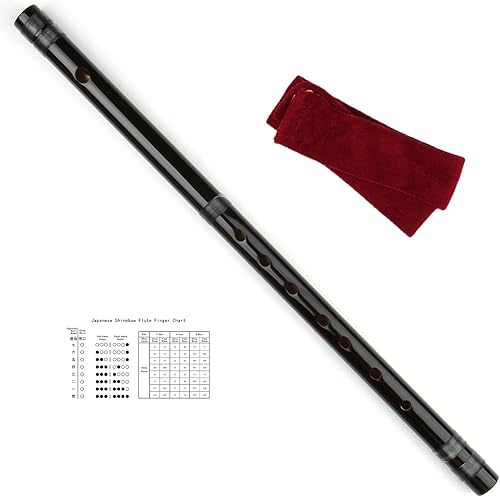
The Japanese Shinobue Flute in Black 7Hon offers an alternative visual style to traditional exposed bamboo while retaining the core acoustic properties of handmade bamboo instruments. Crafted for musical and festival use, this 7Hon flute delivers the bright, piercing timbre characteristic of shinobue design.
The exterior finish provides a polished, uniform appearance while the interior and core structure remain true to traditional bamboo flute crafting techniques. It is well-suited for performers who appreciate a darker aesthetic for stage or ensemble presentations.
What stands out
- Handmade bamboo construction finished in a sleek black exterior.
- 7Hon tuning specification for standard shinobue repertoire.
- Engineered for traditional Japanese festivals and musical performances.
What to consider
- Black exterior coating conceals the natural bamboo grain favored by some purists.
- 7Hon sizing requires matching with appropriate ensemble keys.
Bottom line: A striking black-finished 7Hon handmade bamboo shinobue flute built for festival and musical applications.
8. Shinobue 6hole7hon Flute
Best for players searching for a specialized 6-hole, 7-hon handmade bamboo shinobue flute configured for festivals and traditional music.

This Japanese Shinobue Flute is handmade from natural bamboo specifically for festivals and traditional music applications. Configured with six finger holes in a 7hon pitch arrangement, it caters to specific regional and folk performance styles that utilize the six-hole fingering system.
The careful hand-building process ensures that the bamboo tube resonates clearly when played, producing the bright and lively tone required to cut through outdoor festival environments and ensemble instrumentation.
What stands out
- Handmade bamboo construction designed for festivals and music.
- Features a 6-hole finger arrangement in a 7hon pitch.
- Authentic traditional craftsmanship suited for folk performance styles.
What to consider
- 6-hole fingering layout differs from 7-hole variants, requiring specific fingering practice.
- Natural bamboo requires mindful care regarding temperature and humidity shifts.
Bottom line: A specialized 6-hole 7hon handmade bamboo shinobue flute crafted for traditional festival music.
Understanding Shinobue Flute Craftsmanship
The art of crafting a shinobue flute involves selecting seasoned natural bamboo, curing the material, and meticulously boring the interior to achieve the desired acoustic resonance. Artisans often wrap the bamboo body with rattan or thread to reinforce the tube and prevent splitting while adding a traditional decorative touch. Understanding these construction methods helps musicians appreciate the labor and precision required to produce a balanced, responsive wind instrument.
Different hon sizes and hole configurations dictate the pitch and fingering system of each shinobue. Whether exploring a 7hon model, an 8hon variant, or a six-hole versus seven-hole design, players must select an instrument that aligns with their specific musical context, such as festival accompaniment, folk ensemble playing, or solo meditation.
Comparing Transverse and End-Blown Flutes
World flute traditions offer diverse blowing mechanisms, notably transverse flutes like the shinobue and dizi versus end-blown flutes like the shakuhachi. Transverse flutes are held horizontally across the face, requiring the player to direct a focused stream of air across the embouchure hole. This design allows for rapid articulation and dynamic projection across various musical scales.
Conversely, end-blown instruments like the shakuhachi require the player to hold the flute vertically and blow directly against a shaped rim or blowing edge. This vertical orientation grants intimate control over pitch bending, timbre variation, and breath nuance, making it a favorite for meditative and expressive solo performances across multiple octaves.
Selecting the Right Material and Finish
Material choice plays a foundational role in the sound, feel, and longevity of traditional flutes. Natural bamboo remains the benchmark for instruments like the shinobue, dizi, and shakuhachi, offering organic warmth and acoustic brilliance. Some bamboo flutes feature natural finishes showcasing the raw grain, while others incorporate decorative elements like red lines, wrappings, or black exterior coatings.
For Western-style instruments like the EastRock student model, silver nickel construction provides rugged durability and consistent mechanical keywork. Meanwhile, instruments like the Stellar cedar flute demonstrate the acoustic qualities of softwoods, delivering distinct resonant profiles that differ from both bamboo and metal orchestral flutes.
Care and Maintenance for Bamboo Flutes
Natural bamboo instruments demand specific maintenance routines to ensure longevity and prevent structural damage caused by environmental fluctuations. Because bamboo is an organic material, sudden changes in temperature and humidity can cause the wood to expand, contract, or crack. Storing flutes in protective cases when not in use helps mitigate these risks.
Additionally, players should be mindful of moisture accumulation inside the bore after playing. Wiping the interior dry with a soft cloth or cleaning rod helps maintain the integrity of the bore and preserves the clean acoustic response of the instrument during subsequent practice sessions.
Exploring Global Folk and Student Flute Traditions
Venturing beyond standard orchestral instruments opens up a rich landscape of global folk traditions. From the vibrant melodies produced by a Chinese bitter bamboo dizi with its vibrating membrane to the contemplative tones of a Japanese shinobue at a lively festival, each instrument tells a story rooted in its cultural origins.
Beginners and students exploring these traditions benefit from comprehensive packages that include instructional books, membranes, cleaning kits, or protective cases. These bundled resources ease the transition into new playing styles, ensuring that musicians have the guidance and accessories needed to develop their skills successfully.
Frequently Asked Questions About Shinobue and World Flutes
What is the difference between a 7hon and an 8hon shinobue? The hon designation refers to the pitch standard of the shinobue. An 8hon flute generally produces a higher pitch than a 7hon instrument, allowing players to match different ensemble keys and musical arrangements.
Are shinobue flutes suitable for beginners? While traditional bamboo flutes require an adjustment to embouchure and breath control, models are crafted for players at various levels. Beginners should take time to practice basic tone production and finger placement.
What is the purpose of the membrane on a dizi flute? The membrane, often made from reed or bamboo paper, is pasted over a dedicated hole on the Chinese dizi. It vibrates sympathetically with the air column, producing the characteristic bright, buzzing timbre of the instrument.
Can shakuhachi flutes play across multiple octaves? Yes, quality shakuhachi flutes such as the 1.8-foot TOZAN-ryu model are engineered to play all octaves, accommodating both seasoned flautists and players at any level through refined breath technique.
How should natural bamboo flutes be stored? Natural bamboo flutes should be stored in stable environmental conditions away from extreme heat and direct sunlight. Using a protective case helps shield the instrument from humidity shifts and physical impacts.
Final Thoughts
The journey into traditional wind instruments offers a rewarding exploration of culture, craftsmanship, and acoustic artistry. Whether you are drawn to the vibrant festival energy of a Japanese shinobue, the meditative depth of a shakuhachi, the bright folk melodies of a dizi, or the structured learning of cedar and orchestral flutes, each instrument offers a unique voice.
By carefully evaluating materials, tuning systems, and included accessories, musicians can find the ideal instrument to match their skill level and creative aspirations. Embracing these diverse musical traditions enriches practice routines and connects players to centuries of global heritage.