
Upright bass open strings form the foundational pitch architecture for orchestral low-end harmony, tuned traditionally in fourths from lowest to highest as E1, A1, D2, and G2. These unstopped pitches provide crucial acoustic anchors for ensemble tuning, structural chord roots, and physical reference points for left-hand shifting.
Because of the sheer physical scale of the instrument, playing open strings effectively requires careful management of bow weight, arm height, and string friction. Amateurs must master how these thick metal-wrapped strings respond to different bow speeds and contact points to project clearly within a symphonic texture.
Understanding open string behavior also aids in orchestral score reading and rehearsal awareness, as composers frequently utilize these ringing, resonant notes for pedal points, dramatic ostinatos, and powerful harmonic foundations that support the entire woodwind and string sections.

Acoustic Foundations of Standard Open Strings
Pitch Layout and Intervals
The standard orchestral upright bass is tuned in descending fourths: G2, D2, A1, and E1. This interval structure differs from the violin family, which relies on fifths, altering how players visualize fingerboard geometry.
Each open string sounds an octave lower than standard written notation indicates, a transposition convention designed to keep orchestral scores readable. Recognizing this layout helps players quickly verify instrument tuning against section mates before rehearsals begin.
String Thickness and Tension
Bass strings possess massive mass and high physical tension compared to other orchestral strings. The thickest string, E1, requires significant energy from both arms to set the heavy core into stable vibration.
This substantial physical mass means open strings resist immediate sound production if attacked carelessly. Players must develop a patient, heavy stroke that draws the deep fundamental frequency out of the instrument without choking the natural resonance.
Register and Orchestral Role
The four open strings cover the core lower register of the symphonic orchestra, underpinning cellos and low woodwinds. Their rich harmonic spectra project substantial acoustic power when bowed cleanly.
Composers leverage these specific pitches for foundational basslines where maximum acoustic weight is required. Amateurs must balance open string usage carefully to avoid overwhelming lighter textures in delicate classical passages.
When exploring fundamental resonances, studying the acoustic response of double bass open strings provides essential insight into instrument projection.
For closely related guidance, see upright bass bridge setup.
Bow Mechanics Across Lower String Registers
Weight Distribution and Friction
Producing a clear tone on upright bass open strings demands a heavy bow arm combined with relaxed shoulder joints. The player must apply downward gravity directly into the stick rather than forcing the hair horizontally.
Insufficient weight results in a thin, scratchy sound, while excessive pressure crushes the string and stops vibration entirely. Finding the precise friction balance requires careful listening to the fundamental pitch and upper partials.
Contact Point Management
The bow contact point must shift slightly depending on which open string is sounding. Thicker strings like E1 and A1 generally require a contact point somewhat closer to the bridge to maintain clarity.
Moving the bow too far toward the fingerboard on lower strings produces a fuzzy, unfocused tone lacking core. Players learn to micro-adjust their bow lane continuously to ensure each open string speaks with equal authority.
Crossing Strings Smoothly
Moving cleanly between open strings involves maintaining consistent bow elbow levels to avoid accidental double stops. The right arm must travel through distinct physical planes to transition from the E string to the G string.
Practicing slow string crossings builds the muscle memory necessary for seamless orchestral playing. Clean execution prevents unwanted scraping noises and preserves the rhythmic momentum of fast, articulated passages.

Left Hand Alignment with Open Pitches
Auditory Reference Points
Open strings serve as unalterable auditory tuning pillars for the left hand. Because their pitch never changes during performance, players rely on them to check stopped notes and adjust intonation dynamically.
Comparing fingerboard stops directly against ringing open strings helps develop reliable muscle memory and relative pitch accuracy. This acoustic feedback loop is essential for amateur musicians playing in complex orchestral keys.
Shifting from Open Anchor Points
Shifting away from an open string requires the left hand to abandon its lowest anchor position and travel up the fingerboard. Players must maintain tactile contact with the neck to ensure accurate hand placement upon returning.
Hesitation during these shifts can disrupt the rhythmic flow of a bassline. Practicing deliberate hand movement establishes spatial awareness across the large fingerboard topography safely and efficiently.
Double Stopping and Harmonics
Combining open strings with stopped notes creates resonant double stops that enrich symphonic textures. Similarly, light finger pressure on specific nodes produces clear natural harmonics above the open pitch.
These techniques expand the expressive palette of the instrument without requiring complex thumb position mechanics. Orchestral players use natural harmonics to execute bell-like sustained tones in specialized repertoire.
Instrument Maintenance and String Care
Humidity Fluctuations and Pitch
Changes in relative humidity and room temperature directly impact wooden instruments and metal strings. As concert halls warm up, wooden bass bodies expand, frequently causing strings to go sharp or flat.
Players must check their open string tuning regularly throughout rehearsals to compensate for environmental shifts. Ignoring these thermal changes quickly leads to intonation discrepancies across the entire string section.
Bridge Alignment and Tension
The extreme tension of upright bass open strings exerts immense pressure downward onto the bridge and top plate. The bridge must remain perfectly upright, with feet flat against the wood surface.
String friction during tuning can slowly pull the bridge out of vertical alignment. Regular inspection prevents warping or sudden collapses that could damage the instrument or injure nearby musicians.
Cleaning and Residue Removal
Rosin dust accumulates rapidly on open strings, dampening their natural brilliance and responsiveness. Regular wiping with a soft, dry cloth after every playing session removes sticky rosin buildup effectively.
Allowing residue to harden on the metal windings degrades string longevity and dulls the acoustic output. Proper cleaning maintenance ensures each open string maintains its clear fundamental tone over time.
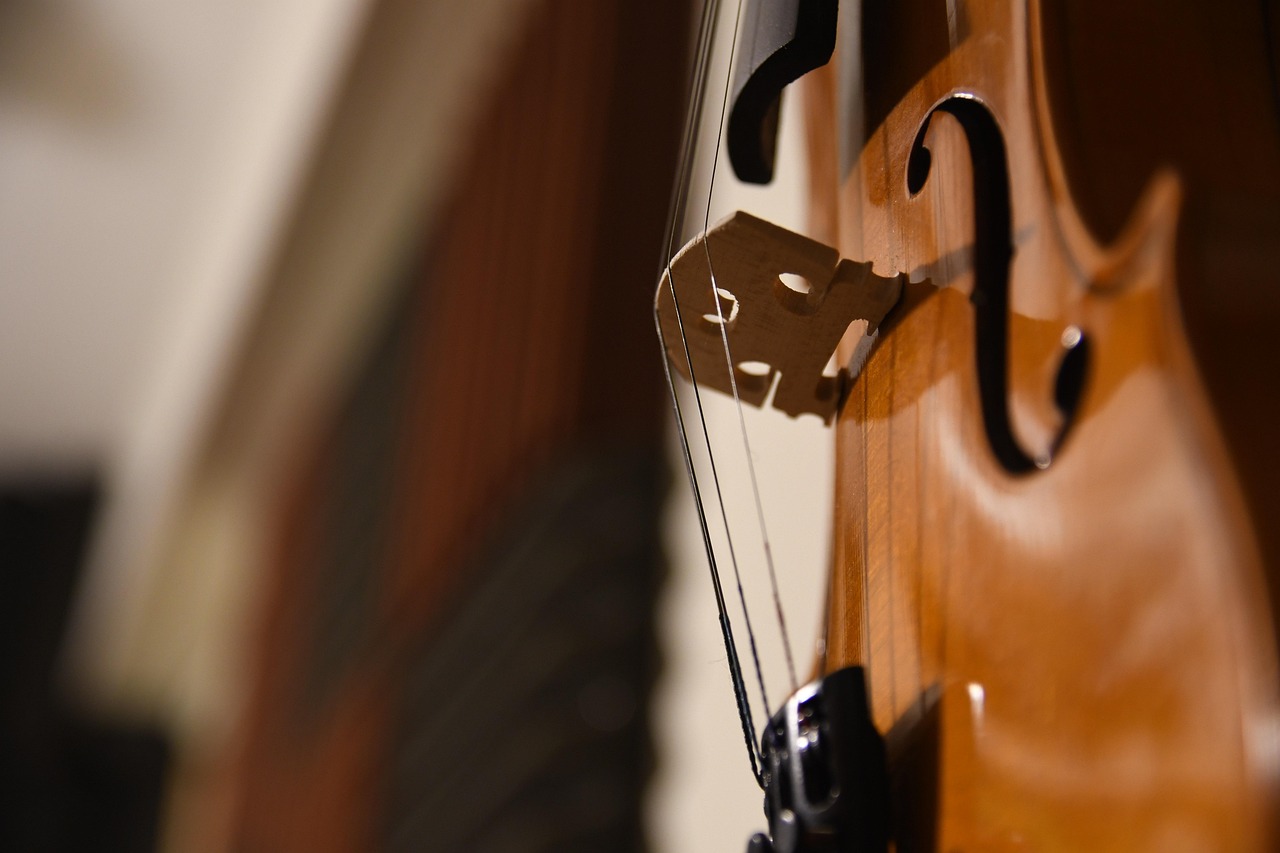
Regularly cleaning double bass strings removes rosin buildup and preserves the bright tone required for optimal acoustic performance.
Frequently Asked Questions
What are the standard notes of upright bass open strings?
The standard orchestral upright bass is tuned in fourths, sounding the notes E1, A1, D2, and G2 from lowest to highest. These four pitches form the absolute foundation of the instrument’s range and play a vital role in orchestral harmony.
Although written an octave higher in sheet music to simplify reading, they sound deep in the contrabass register. Orchestral arrangements heavily feature these open pitches to anchor heavy tutti passages and rhythmic ostinatos.
Why do upright bass strings feel so high in tension compared to electric bass?
Upright bass strings are much thicker, longer, and constructed with heavy steel, synthetic, or gut cores requiring massive physical tension to reach standard acoustic pitch. This physical scale is necessary to project sound across a large symphonic hall without amplification.
Unlike electric basses that rely on magnetic pickups and electronic amplification, the acoustic upright bass depends entirely on string mass driving a large wooden bridge and soundboard. Consequently, players must develop substantial hand strength and efficient arm weight transfer.
How can amateur orchestra players ensure open strings sound in tune with the section?
Amateur players should always tune their open strings using a reliable reference pitch, such as an oboe A or an electronic tuner, before every rehearsal. Because temperature fluctuations in rehearsal spaces alter string pitch rapidly, checking intervals within the section is critical.
Listening closely to neighboring bassists while bowing open strings helps blend the section’s sound. Adjusting tuning pegs incrementally and stabilizing the bridge prevents sudden pitch slips during intense orchestral passages.
How do orchestral composers typically utilize upright bass open strings in symphonic scores?
Composers frequently write upright bass open strings into orchestral scores to anchor key structural moments, especially in foundational keys like E minor, A major, and D minor. Because these unstopped notes vibrate with maximum acoustic resonance, they provide an unyielding tonal foundation that supports low woodwinds, brass instruments, and cellos effortlessly across large symphonic concert halls without requiring complex left-hand stopping.
When score reading, conductors and amateur musicians look for open string pedal points that sustain underlying harmonic tension through shifting orchestration. Recognizing these specific notations helps players prepare the heavy bow stroke required to sustain long, resonant lines without exhausting their arms during prolonged classical symphonic movements.
What causes upright bass open strings to buzz or rattle during rehearsal, and how can it be resolved?
Open string buzzing typically occurs when upright bass open strings vibrate against the fingerboard due to insufficient bow clearance, excessive playing force, or a bridge that has shifted out of alignment. Because bass strings possess massive physical mass and wide oscillation amplitudes, even minor mechanical adjustments can cause the heavy metal-wrapped core to strike the wood.
Amateur musicians should first inspect the bridge feet to ensure they sit flat against the instrument top without leaning forward or backward. Checking the string height at the nut and verifying that the tailpiece wire is secure will eliminate most mechanical rattles, restoring a clean, projecting fundamental tone to the section.
How can amateur musicians use upright bass open strings to improve left-hand intonation and shifting accuracy?
Players can practice matching stopped notes on higher strings against the unalterable pitch of adjacent upright bass open strings to develop precise relative pitch control. This acoustic exercise exposes minor intonation discrepancies immediately, as the interference beats between mismatched frequencies create a wavering sound that trains the ear to find absolute zero-beat accuracy.
When shifting up the fingerboard, starting or ending phrases near an open string anchor point gives the left hand a reliable tactile and auditory reference. Incorporating these cross-string checks into daily warm-ups builds dependable spatial awareness across the massive fingerboard topography, ensuring confident execution in complex orchestral repertoire.
How do natural harmonics function on upright bass open strings, and when are they used in orchestral music?
Natural harmonics are produced by lightly touching upright bass open strings at precise fractional nodes, such as the exact midpoint or the third octave division, rather than pressing them down to the fingerboard. This technique divides the vibrating string into smaller segments, generating clear, bell-like upper partials that sound significantly higher than the fundamental open pitch.
Orchestral arrangers occasionally utilize these shimmering harmonics in specialized repertoire to create ethereal, floating textures that contrast sharply with the heavy, grounded nature of standard low-register playing. Amateurs must master a light left-hand touch and a fast bow speed near the fingerboard to make these delicate overtones project clearly across the orchestra.