Replacing violin strings is an essential part of instrument maintenance that every player encounters throughout their musical journey. Whether you are transitioning from student accessories to professional setups or simply refreshing a worn-out set, understanding your options ensures your instrument maintains optimal resonance, intonation, and playability across all repertoires.
This comprehensive guide examines a diverse selection of violin string sets available on the market today. By analyzing specific core materials, gauge specifications, and instrument compatibility factors, players of all skill levels can make informed decisions when selecting their next set of replacement strings.
1. Pirastro Tonica Strings
Best for professional and student violin players seeking a premium replacement accessory with balanced tone production and dependable tuning stability.

The Pirastro Tonica string set is crafted to meet the demanding standards of both developing students and seasoned professionals. Featuring a medium gauge build paired with a ball end E string, this configuration delivers reliable performance across diverse musical environments.
At the heart of these strings is a fine flexible synthetic core, which contributes significantly to their rich acoustic character and responsiveness under the bow. Synthetic cores are widely favored for offering warmth similar to gut strings while retaining the stability and longevity of modern engineering.
As a dedicated replacement accessory, this set integrates seamlessly into standard acoustic setups, helping players achieve consistent projection and clear articulation whether practicing solo or performing in ensemble settings.
What stands out
- Medium gauge tension designed for balanced resistance and tone
- Equipped with a convenient ball end E string for easy installation
- Built using a fine flexible synthetic core for enhanced resonance
What to consider
- Synthetic core materials generally require a brief settling-in period after initial installation before reaching absolute pitch stability
- Medium gauge tension may require specific adjustments if the player is transitioning from ultra-light or heavy string configurations
The Pirastro Tonica set provides a dependable balance of synthetic warmth and professional-grade construction for players seeking reliable daily performance.
2. Imelod Violin Strings
Best for musicians looking for a universal full set covering G, D, A, and E notes across multiple instrument sizes.
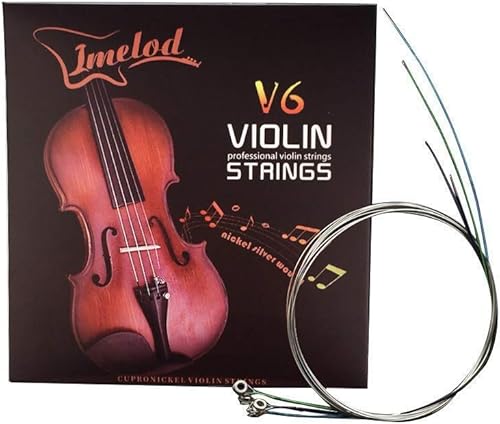
The Imelod universal full set provides a complete G-D-A-E configuration designed to accommodate a wide variety of instrument dimensions. This makes it a practical option for households or teaching studios managing multiple fractional instruments alongside full-size models.
Constructed with a steel core and nickel-silver winding, these strings offer distinct durability and a bright acoustic response. Steel cores are particularly valued for their resistance to humidity changes and immediate stability upon installation.
Additionally, the inclusion of nickel-plated ball ends simplifies the string-changing process, allowing players to secure each string firmly against the tailpiece without excessive slipping or complex looping techniques.
What stands out
- Universal full set covering G, D, A, and E string positions
- Features a resilient steel core with nickel-silver winding
- Includes nickel-plated ball ends for secure tailpiece attachment
What to consider
- Steel core strings often produce a brighter, more direct tone that may feel less warm compared to synthetic or gut alternatives
- Universal sizing requires careful selection of the correct instrument scale length prior to installation
This Imelod set delivers straightforward durability and broad size compatibility for everyday practice and student use.
Related: Playing and Tuning Upright Bass Open
3. Lykos Violin Strings
Best for players at all levels requiring a multi-pack universal string set featuring specialized core and winding materials.

The Lykos 2-pack full set offers versatile G-D-A-E string configurations designed to support violins ranging from full size down to smaller fractional measurements. Providing multiple sets in a single package makes this option efficient for frequent string changers.
These strings incorporate a stainless core combined with Almag wound construction, marrying corrosion-resistant steel durability with specialized alloy characteristics tailored for smooth acoustic delivery.
Engineered for all levels of musicianship, the construction supports students learning proper finger placement as well as experienced players needing reliable backup strings during travel or rigorous practice schedules.
What stands out
- Convenient 2-pack full set providing multiple G-D-A-E configurations
- Stainless core construction offering enhanced resistance to wear
- Almag wound design engineered for consistent performance across skill levels
What to consider
- Almag and stainless steel combinations yield a distinct tonal profile that may alter the existing acoustic balance of dark-sounding wood instruments
- Having multiple packs necessitates proper dry storage to prevent oxidation before future installation
Lykos provides a practical multi-pack solution combining stainless durability with wide-ranging instrument compatibility.
Related: How to Produce a Rich Violin
4. 8 Pieces Violin Strings
Best for student beginners and musical enthusiasts needing replacement strings that span multiple fractional and full-size instruments.

This 8-piece violin string set provides comprehensive G-D-A-E replacements tailored for student beginners and enthusiasts alike. By supplying multiple strings in a single collection, players can easily replace individual broken strings or refresh an entire instrument outfit.
Designed as direct replacement strings, they are built to accommodate 4/4, 3/4, 1/2, and 1/4 size violins, making them exceptionally versatile for growing students transitioning through different fractional instrument sizes.
The inclusion of a quality steel core ensures that each string maintains structural integrity under tension, supporting stable intonation throughout daily practice sessions and instructional settings.
What stands out
- Comprehensive 8-piece collection covering all four string positions
- Engineered as replacement strings for 4/4, 3/4, 1/2, and 1/4 violins
- Quality steel core construction designed for student beginners and enthusiasts
What to consider
- Steel core strings prioritize longevity and stability over the complex harmonic overtones found in premium synthetic options
- Managing an 8-piece assortment requires careful organization to keep individual gauges sorted correctly
This multi-piece steel core set offers dependable utility and broad sizing flexibility for learners at various stages of development.
Related: Understanding Violoncello da Spalla Tuning and
5. Fansjoy Violin Strings
Best for players seeking universal nickel-plated ball end strings compatible with standard and fractional instruments.

The Fansjoy 2-set violin string package delivers universal G-D-A-E configurations equipped with nickel-plated ball ends. This design choice facilitates secure anchor placement on standard tailpieces equipped with fine tuners.
Specifically engineered to be compatible with 4/4 and 3/4 violins, these universal strings bridge the gap between common instrument sizes, ensuring a proper fit for standard student and intermediate setups.
Supplying two complete sets in one package provides excellent preparedness for players who experience unexpected string snaps during intense rehearsal schedules or teaching sessions.
What stands out
- Includes two complete sets of G-D-A-E violin strings
- Equipped with nickel-plated ball ends for reliable tailpiece seating
- Compatible with both 4/4 and 3/4 violin instrument sizes
What to consider
- Compatibility is limited to 4/4 and 3/4 sizes, excluding smaller fractional instruments like 1/2 or 1/4 scales
- Universal tension profiles may feel stiffer on certain older instrument builds compared to low-tension alternatives
Fansjoy delivers a convenient multi-set package focused on reliable ball-end installation and standard size compatibility.
6. JSI Special Strings
Best for musicians desiring a hybrid string combination featuring gold label ball-end E and dominant medium gauge lower strings.

The JSI Special 4/4 violin string set offers a curated hybrid configuration combining specialized components. It pairs a Gold Label ball-end E string with Dominant A, D, and G strings to create a refined acoustic response.
All included strings adhere to medium gauge specifications, ensuring balanced playing tension across the fingerboard and predictable resistance for both bowing and left-hand fingering techniques.
This combination brings together renowned string elements, allowing 4/4 violin players to experience the distinct brilliance of a gold label E alongside the flexible synthetic warmth of dominant inner and G strings.
What stands out
- Features a Gold Label ball-end E string for brilliant high-register projection
- Includes Dominant A, D, and G strings for proven synthetic core warmth
- Balanced medium gauge tension across the entire four-string setup
What to consider
- Hybrid sets combine different manufacturing philosophies, which may require a brief adjustment period for the player’s bowing technique
- Specific matching requirements mean individual string replacements should adhere to the same brand tier for optimal balance
JSI Special provides a thoughtfully blended set that leverages classic string components for 4/4 violin configurations.
7. Pirastro Evah Strings
Best for professional players demanding medium gauge performance paired with a steel ball-end E string.

The Pirastro Evah Pirazzi 4/4 violin string set represents a high-performance option designed for advanced musicians who demand exceptional projection, complex overtones, and immediate bow response.
Built to medium gauge specifications, the set maintains a balanced feel under the fingers while delivering powerful volume that easily carries through large concert halls and ensemble performances.
The inclusion of a steel ball-end E string ensures crisp, clear articulation in the highest register, complementing the sophisticated synthetic core construction of the lower strings.
What stands out
- Medium gauge tension profile optimized for professional playing dynamics
- Features a responsive steel ball-end E string for clear high notes
- Advanced synthetic core design engineered for rich overtones and powerful projection
What to consider
- High-performance synthetic strings typically command a higher investment compared to standard student steel options
- Powerful projection can sometimes overwhelm smaller or overly bright instruments if not properly balanced
Pirastro Evah Pirazzi strings offer top-tier acoustic performance and projection for advanced 4/4 violinists.
8. Replacement Steel Strings
Best for players needing a multi-pack of stainless steel 4/4 size strings covering all standard pitches.

This 3-pack full set replacement offering consists of stainless steel 4/4 size violin strings covering E, A, D, and G pitches. It is designed for straightforward maintenance and dependable long-term durability.
Utilizing stainless steel as the core and structural material provides exceptional resistance to environmental fluctuations such as humidity and temperature shifts, making them resilient travel companions.
Supplying three complete sets ensures that players, teachers, and workshop technicians have an ample supply of replacement strings readily available for routine maintenance and emergency swaps.
What stands out
- Includes three complete sets of 4/4 size violin strings
- Full E, A, D, and G pitch coverage in every set
- Constructed from stainless steel for enhanced longevity and climate resistance
What to consider
- Stainless steel construction delivers a sharp, direct tone that lacks the organic warmth of synthetic or gut-wound alternatives
- Strictly sized for 4/4 instruments, making them unsuitable for fractional student violins
This multi-pack of stainless steel strings provides rugged durability and ample quantity for regular 4/4 violin upkeep.
Understanding Violin String Materials
Violin strings have evolved significantly from traditional sheep gut to modern synthetic and steel alternatives. Steel core strings are celebrated for their durability, immediate tuning stability, and bright acoustic output, making them a popular choice for student beginners and fiddlers. However, they often lack the complex harmonic warmth desired in classical performance settings.
Synthetic core strings, on the other hand, bridge the gap by utilizing advanced polymer materials that mimic the warm, rich sound of gut while retaining the reliability and weather resistance of modern manufacturing. Choosing the right material depends heavily on your instrument’s natural acoustic tendencies and your personal performance goals.
The Role of String Gauges
String gauge refers to the thickness and tension of the string, which directly influences how the instrument responds to your bow and left hand. Medium gauge strings are the industry standard, offering a versatile balance between projection, playing comfort, and resistance. They suit a wide variety of playing styles and instruments.
Light or thin gauges require less finger pressure to depress and bow response is quicker, but they may lack maximum volume and can rattle if bowed too aggressively. Heavy gauges provide maximum volume and deep resonance but demand greater physical strength and precise finger placement to play in tune comfortably.
Instrument Size Compatibility
Ensuring correct size compatibility is critical when purchasing replacement strings for a violin. While full-size (4/4) violins accommodate standard string lengths easily, fractional instruments such as 3/4, 1/2, 1/4, and smaller require strings specifically scaled to their shorter string lengths and smaller tailpieces.
Attempting to install standard 4/4 strings on a fractional instrument results in excessive tension, incorrect string height, and potential damage to the pegbox or tailpiece. Always verify your instrument’s exact size classification before selecting a replacement set.
Installation and Break-In Periods
Replacing violin strings is a routine maintenance task, but it requires patience and proper technique. It is generally recommended to replace strings one at a time rather than removing all four simultaneously, as this maintains the downward pressure on the bridge and prevents the soundpost from falling out of position.
Once new strings are installed and brought up to pitch, they require a break-in or stretching period. Synthetic strings, in particular, need time to settle and stabilize in pitch, whereas steel strings usually reach stable tuning much faster. Regular playing and gentle tuning adjustments during the first few days will help the strings settle properly.
Maintenance and When to Replace
Over time, violin strings accumulate rosin dust, skin oils, and microscopic wear that degrades their acoustic quality and intonation accuracy. Even if a string does not break physically, it will eventually lose its clear tone, become false (unable to play in tune across intervals), or show signs of winding fraying.
Wiping down your strings with a clean, dry microfiber cloth after every practice session helps remove corrosive residue and extends their lifespan. Regular inspection of the string contact points at the nut and bridge will also prevent premature snapping during tuning.
Frequently Asked Questions
How often should I replace my violin strings?
The frequency of string replacement depends on how often you play. Students and regular players typically change their strings every six to twelve months, while professional musicians may replace theirs every few months or before major performances to ensure optimal tonal brilliance and intonation accuracy.
Can I mix different brands of violin strings on the same instrument?
Yes, many players mix and match specific strings—such as pairing a specialized E string with synthetic inner and G strings—to fine-tune their instrument’s acoustic balance. However, mixing strings requires careful attention to tension compatibility to avoid overpowering certain registers.
Why do my new violin strings keep going out of tune?
New strings naturally stretch and settle when first brought up to pitch, especially synthetic and gut cores. This break-in period is normal and typically resolves within a few days of regular playing and minor tuning adjustments.
Are ball-end strings better than loop-end strings?
Ball-end strings are generally easier to install and are widely used with modern tailpieces equipped with built-in fine tuners. Loop-end strings are more commonly found on certain specialized E strings and require specific fine tuner hooks for secure attachment.
What happens if I change all four violin strings at once?
Removing all four strings simultaneously relieves all pressure on the bridge, which can cause the wooden bridge and soundpost inside the instrument to collapse. It is safest to replace strings one at a time to maintain structural stability.
Final Thoughts
Selecting and replacing violin strings is a rewarding process that allows you to continually refine your instrument’s voice and playability. By understanding the distinct characteristics of steel and synthetic cores, matching correct gauges, and verifying instrument size compatibility, you can ensure your violin sounds its absolute best.
Whether you choose reliable student steel sets or advanced professional synthetic configurations, proper maintenance and careful installation will keep your instrument ready for every practice session, rehearsal, and performance.