Finding the ideal flute involves understanding the distinct features, materials, and configurations available on the market today. Whether you are searching for an instrument for a school band, orchestral practice, or professional performances, navigating the options can significantly impact musical growth and enjoyment. This comprehensive review explores a wide selection of flutes ranging from student models to advanced instruments, highlighting specific structural attributes like open-hole designs, closed-hole configurations, offset G keys, split E mechanisms, and included accessories.
Our editorial analysis breaks down eight distinct flute selections based strictly on their documented specifications and intended applications. By examining key components such as silver-plated keys, nickel silver construction, B-foot joints, and included maintenance kits, players and educators can make informed decisions. Read on to discover detailed breakdowns of each instrument, practical buying guide sections, and answers to common questions regarding flute selection and upkeep.
1. Open Hole C Flute Pro
Best for musicians seeking a professional-grade instrument tailored for school band, regular practice, and advanced performance settings.

This open-hole C flute features a comprehensive 17-key layout paired with a B-foot joint, providing the extended range and acoustic depth often required in serious ensemble environments. The inclusion of an offset G key and a split E key assists players in achieving smooth finger positioning and precise intonation across challenging musical passages. Its silver finish provides a classic aesthetic suitable for both rehearsal rooms and stage performances.
Designed to support school band members as well as dedicated soloists, the instrument bridges the gap between student-level accessibility and professional capability. The open-hole mechanism encourages proper hand positioning, as players must fully cover the tone holes to produce a clean sound. Coupled with the B-foot joint, this configuration allows advanced players to execute complex repertoire with confidence and tonal clarity.
The structural layout emphasizes ergonomic comfort through its offset G configuration, reducing hand strain during extended practice sessions. The split E key further stabilizes the high E response, making it a reliable choice for performers navigating demanding orchestral and concert band arrangements.
What stands out
- Equipped with 17 keys and a B-foot joint for extended range
- Features an offset G and split E key for enhanced playability
- Suited for professional settings, school bands, and performances
What to consider
- Open-hole key mechanisms require more precise finger placement than closed-hole alternatives
- B-foot joint configurations add length and weight compared to standard C-foot instruments
Bottom line: An advanced choice for musicians needing professional features like a B-foot joint and split E mechanism for rigorous band and performance use.
2. Closed Hole C-Flute
Best for newer players and developing musicians participating in band and orchestra programs.

Constructed from nickel, this closed-hole C flute serves as a dependable musical instrument for individuals establishing their foundational skills in school music programs. The closed-hole design simplifies finger placement, allowing developing students to focus on breath support, embouchure formation, and basic tone production without worrying about sealing open key cups.
The instrument is specifically configured for beginner and intermediate players performing within band and orchestra settings. Its sturdy nickel construction offers durability to withstand daily transport to and from rehearsal spaces, classrooms, and home practice areas. The reliable mechanism ensures consistent response across standard student repertoire.
By prioritizing ease of use and structural resilience, this model supports students as they transition from early instructional books to ensemble playing. The closed keys provide a secure seal with minimal finger pressure, fostering confidence during group rehearsals and sectional practices.
What stands out
- Closed-hole design simplifies initial finger placement for learners
- Durable nickel construction built for band and orchestra environments
- Ideal musical instrument for beginner and intermediate levels
What to consider
- Closed-hole keys offer less acoustic customization than open-hole professional models
- Nickel material has a different visual and tonal resonance profile compared to sterling silver
Bottom line: A solid, accessible musical instrument designed to support students and intermediate players in band and orchestra settings.
Related: Mastering the High A Flat Note
3. Closed Hole Flute Kit
Best for students and parents looking for an all-inclusive package with essential maintenance tools and storage accessories.

This closed-hole C flute comes complete with a dedicated case, tuning rod, joint grease, cleaning cloth, and gloves, offering everything required for immediate maintenance and safe transport. Crafted from nickel silver, the instrument balances durability with a bright, responsive tone suitable for developing musicians.
The inclusion of a full accessory kit ensures that players can properly maintain their instrument right out of the box. The tuning rod and cleaning cloth assist with moisture removal after each playing session, while joint grease helps assemble and disassemble the headjoint, body, and footjoint smoothly without damaging the tenons.
Additionally, the provided gloves and protective case protect the nickel silver body from fingerprints, oils, and accidental impact during travel. This makes the package particularly convenient for students needing a complete, ready-to-use setup for school music classes.
What stands out
- Includes a protective case, tuning rod, joint grease, cloth, and gloves
- Nickel silver construction provides a durable and responsive body
- Closed-hole layout accommodates developing players
What to consider
- Closed-hole configuration may eventually be outgrown as technical proficiency advances
- Nickel silver requires regular wiping with the included cloth to maintain its finish
Bottom line: A comprehensive flute kit featuring essential maintenance accessories and a durable nickel silver build for student musicians.
Related: Understanding the Order of Flats in
4. Selmer 111 Student Flute
Best for student musicians seeking a trusted brand name and precise mechanical features for educational environments.

Created by Selmer, the 111 student flute incorporates silver-plated keys designed to provide a secure tactile feel and a polished appearance. The integration of a split-E mechanism assists players in producing clean, stable high E notes, a common hurdle for students learning upper-register fingerings.
This model focuses on student-centric ergonomics and reliable intonation, making it a staple recommendation for school music programs. The silver-plated key mechanism ensures smooth action across all keys, promoting agile finger movement during technical exercises and band arrangements.
The construction quality reflects Selmer’s long-standing heritage in wind instrument manufacturing, offering durability and consistent performance. The split-E mechanism specifically enhances stability, allowing young players to tackle challenging band literature with greater assurance.
What stands out
- Engineered by Selmer with a focus on student needs
- Features silver-plated keys for smooth tactile response
- Includes a split-E mechanism for enhanced high-register stability
What to consider
- Student-focused design may lack advanced professional options like a B-foot joint
- Silver-plated components require careful cleaning to prevent tarnishing over time
Bottom line: A dependable student flute from Selmer featuring silver-plated keys and a helpful split-E mechanism.
Related: Playing a Clarinet Fitted With a
5. Jean Paul FL-430 Flute
Best for intermediate players seeking a concert-ready, open-hole instrument with a refined silver-plated finish.

The Jean Paul FL-430 intermediate concert flute offers an open-hole configuration designed for players ready to transition beyond student-level equipment. Its silver-plated body and keys deliver a brilliant tonal projection suitable for concert band and solo performance spaces.
As an intermediate instrument, it encourages proper hand alignment through its open-hole key cups, challenging the musician to refine their finger placement. The silver plating enhances both the visual elegance and the acoustic resonance of the flute.
Musicians upgrading from closed-hole models will find that this concert flute provides greater expressive control over dynamics and intonation. Its responsive mechanism facilitates agile execution of intricate musical passages.
What stands out
- Intermediate concert flute with an open-hole design
- Silver-plated finish for enhanced acoustic projection
- Suited for advancing players developing precise finger technique
What to consider
- Open-hole design demands accurate finger coverage for proper note emission
- Requires a transition period for players moving from closed-hole instruments
Bottom line: An intermediate concert flute offering open-hole performance and a silver-plated finish for advancing musicians.
6. YFL-222 Student Flute
Best for students entering band programs who require an internationally recognized standard in student flutes.
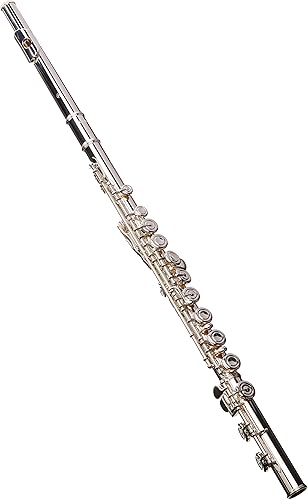
The YFL-222 is crafted specifically as an intermediate flute for students, distributed as an international version tailored for educational settings. Its design emphasizes durability, accurate intonation, and a comfortable playing position for younger or smaller hands.
The instrument provides a stable platform for foundational skill development, ensuring that students can produce a clear tone without excessive physical effort. The key mechanisms are proportioned to support proper hand posture during long band rehearsals.
Built to withstand the rigors of daily student use, this model maintains its regulation well over time. It remains a frequent choice among music educators looking for dependable equipment for their school ensembles.
What stands out
- Designed specifically as a student flute for educational use
- International version built for reliable intonation and durability
- Comfortable ergonomics suited for developing players
What to consider
- Standard student configuration may not include advanced mechanisms like split-E
- Geared primarily toward learners rather than advanced performers
Bottom line: A trusted international student flute built to deliver reliable intonation and durability for band members.
7. Model 3OB Open Flute
Best for players searching for an open-hole configuration with an extended B-foot joint and offset G key.

The Model 3OB flute features an open-hole design combined with an offset G key and a B-foot joint, all finished in silver plating. This configuration caters to musicians who require advanced technical capabilities and an extended lower register.
The open-hole keys encourage precise finger technique, while the offset G layout reduces hand fatigue during complex musical pieces. The B-foot joint extends the instrument’s range downward and adds tonal depth appreciated in concert settings.
Silver plating covers the entire instrument, providing a bright tone quality and a polished aesthetic. This model bridges intermediate and advanced playing tiers effectively.
What stands out
- Features an open-hole design for advanced finger technique
- Equipped with an offset G key and a B-foot joint
- Silver-plated finish enhances tone and appearance
What to consider
- Open-hole keys require careful practice to ensure complete tone hole closure
- B-foot joint adds overall weight and length to the instrument
Bottom line: A silver-plated, open-hole flute featuring a B-foot joint and offset G for advancing performers.
8. Belsona Student Flute
Best for beginning students who need a portable, protected instrument package for school band participation.

The Flute PF200 Belsona Student 200 Series C-Flute comes bundled with a sturdy ABS case, making it an optimal choice for students who travel frequently between home and school. The 200 series design focuses on ease of response and reliable mechanical action for early-stage learners.
The included ABS case offers robust protection against bumps and drops during transit, safeguarding the instrument’s alignment and finish. The flute itself is engineered to produce a forgiving, clear tone that encourages students as they learn fundamental notes and rhythms.
With its emphasis on durability and secure storage, this package addresses the practical needs of parents and educators alike. The key action is light and responsive, accommodating developing finger strength.
What stands out
- Belsona Student 200 Series C-flute designed for learners
- Includes a rugged ABS case for secure transport and storage
- Forgiving response supports early skill development
What to consider
- Student series build is optimized for beginners rather than advanced soloists
- ABS case adds bulk compared to lightweight gig bags
Bottom line: A reliable student C-flute packaged with a durable ABS case for safe everyday transport.
Understanding Flute Key Types
When selecting a flute, understanding the difference between open-hole and closed-hole key mechanisms is essential. Open-hole flutes, often favored by intermediate and professional players, feature small holes in the center of the key cups that must be completely covered by the player’s fingers. This design encourages correct hand positioning and allows for extended extended techniques, such as microtones and multiphonics, which are common in advanced concert repertoire.
On the other hand, closed-hole flutes—frequently referred to as plateau keys—cover the tone holes completely. This style is ideal for beginners and younger students because it allows for easy sound production without requiring absolute precision in finger placement right from the start. Educators often recommend closed-hole models for initial band and orchestra participation, transitioning students to open-hole configurations only after proper hand habits are firmly established.
The Role of Footjoints and Range
Flutes typically come with one of two footjoint options: a C-foot joint or a B-foot joint. The C-foot joint is shorter, lighter, and plays down to a low C. It is the standard choice for most student models because it reduces overall weight, making it easier for younger players to hold the instrument horizontally without straining their arms and shoulders during long rehearsal blocks.
Conversely, a B-foot joint adds extra tubing to the instrument, allowing the player to reach a low B. Beyond extending the lower register, the B-foot joint alters the resistance and core sound of the flute, providing a darker, more centered tone projection. While heavier and longer, B-foot joints are standard on professional and advanced models, especially those paired with open-hole mechanisms and split-E keys for complex band and solo performances.
Materials and Finishes
The materials used in flute construction heavily influence both durability and tone production. Student instruments are frequently built from nickel or nickel silver, providing a robust, impact-resistant body that withstands the daily demands of school band rooms. Nickel silver instruments finished with silver plating offer a bright, resonant sound while maintaining structural integrity and affordability.
As players advance, they may encounter instruments with higher silver content or solid silver headjoints and bodies. Silver plating provides the brilliant aesthetic and acoustic qualities of silver while keeping the instrument practical for everyday educational and performance environments. Proper maintenance, including wiping down the instrument with a soft cloth after playing, ensures that plated finishes retain their luster over years of regular use.
Essential Maintenance Accessories
Proper upkeep is critical for maintaining a flute’s playability and extending its lifespan. Many instrument packages include essential cleaning and assembly tools such as a tuning rod, cleaning cloth, joint grease, and protective gloves. The tuning rod is used in conjunction with the cloth to swab out moisture from the interior of the headjoint, body, and footjoint after every playing session, preventing corrosion and pad degradation.
Joint grease is another vital component, helping lubricate the tenons where the flute joints connect. Applying a small amount ensures smooth assembly and disassembly, reducing the risk of bending the metal tubing. Protective gloves and sturdy cases—such as ABS storage cases—further protect the instrument from oils, fingerprints, and accidental impact during travel between home, school, and concert venues.
Key Mechanisms: Offset G and Split E
Ergonomic key mechanisms play a significant role in a player’s comfort and technical agility. An offset G key places the G key slightly out of line with the rest of the left-hand keys, aligning more naturally with the natural curvature of human fingers. This reduces wrist and finger tension, making it particularly beneficial for younger students and players with smaller hands during extended practice routines.
The split E mechanism is another valuable feature found on many intermediate and professional flutes. It assists in stabilizing the high E note, which is notoriously difficult to speak clearly on standard transverse flutes. By splitting the action of the G keys, the mechanism ensures that the upper G tone hole closes when the high E is played, resulting in a cleaner, more reliable response in the upper register.
Frequently Asked Questions
What is the difference between an open-hole and closed-hole flute?
Open-hole flutes feature holes in the centers of the key cups that require precise finger coverage, encouraging correct hand posture and enabling advanced techniques. Closed-hole flutes cover the keys completely, making it easier for beginners to produce a clear sound without worrying about exact finger placement.
Why do some flutes have a B-foot joint instead of a C-foot joint?
A B-foot joint extends the flute’s lower range down to a low B and adds length and weight to the instrument. It also alters the acoustic resistance, providing a darker tone projection favored by advanced players and professional performers.
What maintenance accessories are needed for a flute?
Essential maintenance accessories include a cleaning cloth and tuning rod to remove moisture after playing, joint grease to ease the assembly of metal tenons, and a protective case to prevent damage during transport.
How does silver plating affect a flute?
Silver plating provides a bright, resonant sound quality and a polished aesthetic appearance. It offers many of the acoustic benefits of solid silver while maintaining durability and affordability for students and intermediate musicians.
What do offset G and split E keys do?
An offset G key aligns more naturally with the fingers to reduce hand strain during playing. A split E key stabilizes the high E note, helping players produce a clean and reliable response in the upper register.
Final Thoughts
Choosing the right flute depends heavily on the player’s current skill level, musical goals, and performance environment. Beginners benefit greatly from durable nickel or nickel silver closed-hole models that feature included maintenance kits and protective cases, fostering a smooth learning curve in school band and orchestra settings. These student-oriented instruments prioritize ease of response and structural resilience, ensuring that young musicians can focus on developing proper embouchure and foundational techniques.
As players advance into intermediate and professional tiers, options featuring open-hole mechanisms, offset G keys, B-foot joints, and split-E mechanisms offer the acoustic depth and technical flexibility required for demanding repertoire. By carefully evaluating each instrument’s specifications, materials, and included accessories, musicians, parents, and educators can select a flute that supports continuous musical growth and performance excellence for years to come.